In manufacturing operations, leaders often focus on cost reduction – cutting expenses that already exist. Equally powerful, but frequently underappreciated, is cost avoidance. Cost avoidance prevents future or potential costs from ever occurring. In the context of Smart Manufacturing, cost avoidance is one of the strongest value levers because manufacturing execution sits directly at the intersection of operations, quality, maintenance, and supply chain.
This article explains how cost avoidance can be systematically achieved through Industry 4.0 or smart manufacturing practices, supported by real-world examples and practical implementation approaches.
1. Understanding Cost Avoidance vs Cost Reduction
In manufacturing shop-floor there are numerous activities and operations right from material management and movements, manufacturing execution, quality inspection in production line, which incur running cost which are called OPEX or operational expenditures. These cost elements can be ideally modeled as part of the operations planning process. But there may be additional cost incurred due to unprecedented events, which may lead to significantly high OPEX at times, leading to profitability impact. For every manufacturing planner and plant manager it is an important consideration on how to avoid or minimize the hidden costs that may occur, and if not controlled can lead to significant losses.
Before diving deeper, it is important to distinguish the two:
- Cost Reduction: Eliminating or lowering existing costs e.g. reducing manpower by automation.
- Cost Avoidance: Preventing costs that would otherwise occur e.g. avoiding scrap, recalls, downtime, regulatory penalties, or emergency procurement.
Now the question is there a way to avoid those hidden costs actually? The short answer is YES – Industry 4.0 or smart manufacturing-driven cost avoidance approaches can deliver silent savings – money never spent, rather than money visibly removed from the balance sheet. Industry 4.0 or Smart manufacturing refers to using digital tools and technologies with automation to largely digitalize shop-floor operations and enable real-time visibility across the processes.
Then how to actually realize the same and put it into practice? Let’s explore that in the subsequent sections.
2. Key Cost Avoidance Levers in Manufacturing Execution
There are quite a few levers of cost avoidance in manufacturing execution processes, which when applied right, can lead to substantial cost avoidance. Let’s explore each of the key levers one by one.
Avoiding Scrap and Rework Through Right-First-Time Execution
Scrap and rework are common pitfalls and operational nuances through which sometime significant unplanned cost may incur. Some of the key reasons of increasing scrap or rework during the manufacturing execution process may be due to manual work instructions, outdated SOPs, and operator dependency which may often lead to wrong process step, incorrect parameters and missed inspections.
Smart manufacturing approach mandates using:
- Electronic Work Instructions (EWIs)
- Recipe enforcement and parameter validation
- Mandatory quality checks before step completion
- Automated interlocks preventing process deviation
These approaches can help to avoid or minimize the scrap and rework during operations.
Let’s consider a real example – in an automotive component plant, frequent rework occurred due to skipped torque checks during assembly. Adopting smart manufacturing process with MES and real-time integration with torque tool through OPC:
- Torque verification became a mandatory system step.
- Operators could not proceed without valid readings.
- Scrap and rework incidents dropped by ~40%.
This helped to avoid or minimize the following cost elements:
Preventing Unplanned Downtime via Condition-Based & Predictive Maintenance
Another frequent issue in manufacturing shop-floor is unplanned machine downtime which often cause lost production, overtime costs, missed delivery commitments and emergency maintenance expenses.
Using smart manufacturing approach, a Unified Namespace is created for collecting and processing the asset data from SCADA and other IoT system to achieve the following:
- Integration with machine signals and IoT sensors
- Real-time monitoring of operating conditions
- Automated alerts for abnormal patterns
- Execution rules to stop production before failure
- Predictive models to determine anomalies and potential failure conditions in advance
This led to substantial reduction of the unplanned machine downtime and avoid the cost of lost production and frequent maintenance. Let’s consider an example where a packaging line in a food products manufacturing factory experienced sudden motor failures every few months. By enabling a condition based and predictive maintenance system with Unified namespace the following are achieved:
- Vibration and temperature data were monitored.
- Threshold breaches triggered controlled stoppages.
- Predictive models analyse the timeseries data and predict machine downtimes
- Proactive maintenance was planned during non-peak hours.
This helped to avoid the following costs:
- Line-wide production losses
- Premium freight to recover schedules
Avoiding Quality Escapes and Customer Recalls
Quality of the manufactured product is one of the key factors to control and any significant escapes can lead to warranty claims, product recalls, brand damage and regulatory scrutiny.
Smart manufacturing-based approach enables:
- In-process quality enforcement
- Automatic defect containment
- Lot and serial-level genealogy
- Immediate traceability across materials and operations
This helps to control the defects and prevent unwanted quality issues. In an electronics manufacturing plant, defects were detected late in final inspection.
Using MES and LIMS with digital quality management process the following are achieved:
- In-line quality checks were enforced.
- Defects were identified at the exact operation step.
- Only affected serial numbers were blocked.
This helped to avoid the following costs:
- Costly field replacements
Similarly, costs for compliance failures, excess inventory carrying, frequent engineering changes can be achieved once the digital tools and technologies enabling smart manufacturing process are adopted.
3. Implementation Best Practices for Maximizing Cost Avoidance
To achieve cost avoidance, it is absolutely important to enable visibility across the processes and ability to track certain KPIs to improve those. This is often a journey to be achieved over a period of time with gradual improvements rather than in one go. Below are some of the key aspects which should be ideally followed to achieve the same.
Focus on Prevention Metrics
Track KPIs such as:
Start with high-risk processes by prioritizing
- Regulatory-critical processes
Embed Rules, Not Just Visibility
- Dashboards show problems. Execution rules prevent problems. Determine the actions based on the rules and the KPIs.
Integrate Across Systems
True cost avoidance comes when following systems are well integrated:
4. Measuring Cost Avoidance
Unless the KPIs related to the hidden cost are measured with tracking on how much cost is avoided it is not easy to justify the initial investment needed to enable smart manufacturing process and tools. Cost avoidance is often underestimated because it is ‘invisible’.
To enable the tracking, create analytics dashboards showing the KPIs which indicates the cost avoided with drill-downs and roll-ups from plant to production lines and machines. Of course, to enable that you need to adopt the smart manufacturing tools and technologies such as MES, LIMS, Unified Namespace, IoT etc along with a robust analytics platform, which can collect the relevant data from various data sources and present the KPIs with the drill-down views to track and understand the cost avoided as well as the areas to improve.
Note that effective measurement approaches include:
- Comparing historical incident frequency
- Estimating avoided downtime cost per hour
- Quantifying prevented scrap and rework volume
- Risk-based cost modelling for compliance and recalls
Some of the KPIs which can be monitored to analyse the cost avoidance are as following:
Plant Related KPIs
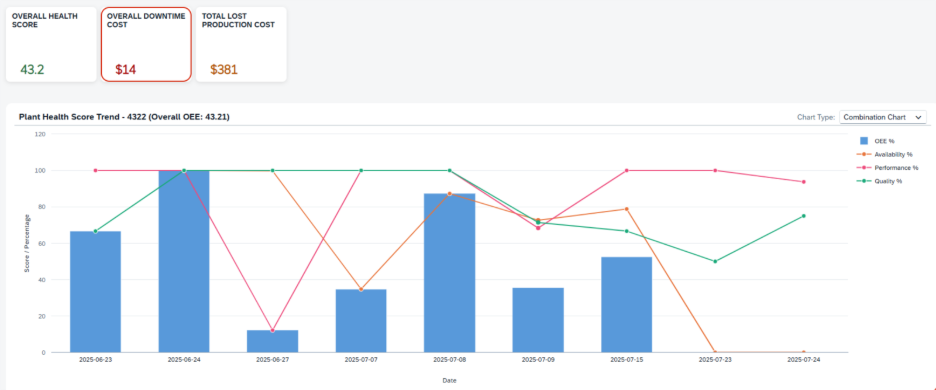
- Plant Health Score = OEE rollups across work centres in the plan
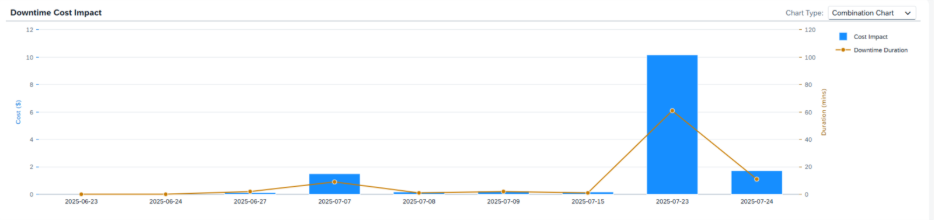
- Downtime Cost Impact = Production Rate × Contribution Margin × Downtime Hours
- Key Downtime Causes = Pareto analysis of downtime reason code by duration and frequency
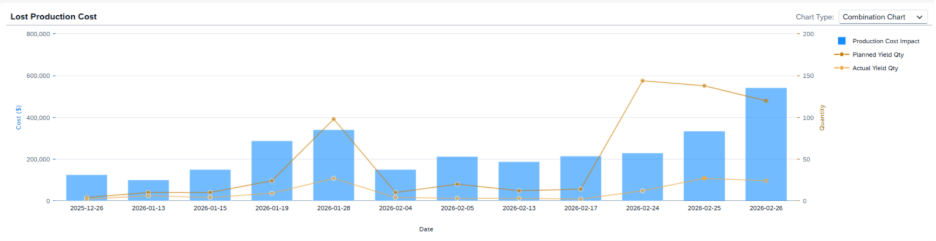
- Lost Production Cost = Yield Deviation x Product Cost
Follow-up Action: Identify key cost impact levers and improvement plan
Asset Related KPIs
- Downtime Prediction = RUL & Anomaly
- Asset Maintenance Effectiveness = MTBF vs MTTR
- Total Maintenance Cost = Spare Parts Cost + Labour Cost
- Avoided Downtime = Predicted Downtime – Actual Downtime
- Avoidable Maintenance Cost = Total Maintenance Cost – Planned Maintenance Cost
Follow-up Actions:
- Update Maintenance Plan → Check spares availability → reduce emergency downtime.
- Identify machine with largest cost impact → SAP PM notification → perform root cause analysis
Production Work center Related KPIs
- Yield Deviation % = ((Planned Yield – Actual Yield)/(Planned Yield)) * 100
- Scrap % = Scrap Qty / Total Qty
- Scrap Cost = Σ(Scrap Qty × Material Cost) + Rework Labor + Energy
- Avoided Scrap Cost = Baseline Scrap Cost – Current Scrap Cost
Follow-up Actions:
- Identify defect patterns → trigger CAPA → investigate batch genealogy.
- Identify bottleneck → review micro-stops → initiate improvement action
Inventory Related KPIs
- Carrying Cost = Inventory Value × Carrying Rate × Days on Hand / 365
- Production Requirements = Qty with Days vs. Qty Available & Planned
- Cost Avoidance = Reduced Days × Carrying Cost per Day
Follow-up Action:
Adjust production schedule → optimize procurement → reduce blocked inventory.
Sustainability Related KPIs
- Energy per Unit = kWh / Units Produced
- Energy Cost = kWh × Tariff
- Cost Avoidance = Baseline Cost – Actual Cost
Follow-up Action:
Identify peak loads → shift usage to off-peak → optimize machine scheduling.
Below are some examples of the KPI analysis for the cost avoidance and tracking
Conclusion
Manufacturing execution is no longer just about tracking production – it is about protecting the enterprise from future losses. By enforcing correct execution, enabling real-time decision-making, and embedding preventive controls, smart manufacturing practices and tools become a powerful engine for cost avoidance.
Organizations that consciously design smart manufacturing programs around cost avoidance and not just automation, unlock sustained operational resilience, higher margins, and competitive advantage.
In modern manufacturing, the most valuable savings are often the ones that never appear as losses at all.